Seminar on Nordic Responses to the Livestock Strategy on 1 October 2026 Gathered One Hundred People to Discuss Trade and Animal Welfare Perspectives - MTK en
Seminar on Nordic Responses to the Livestock Strategy on 1 October 2026 Gathered One Hundred People to Discuss Trade and Animal Welfare Perspectives
News
Seminar on Nordic Responses to the Livestock Strategy on 1 October 2026 Gathered One Hundred People to Discuss Trade and Animal Welfare Perspectives
14.10.2026
The Nordic Livestock Seminar was organized on 1 October by LRF (Federation of Swedish Farmers), MTK (Finnish Central Union of Agricultural Producers and Forest Owners) and DAFC (Danish Agriculture & Food Council). The event highlighted Nordic perspectives on why livestock is crucial for sustaining food security and how sustainability requires economically viable production.
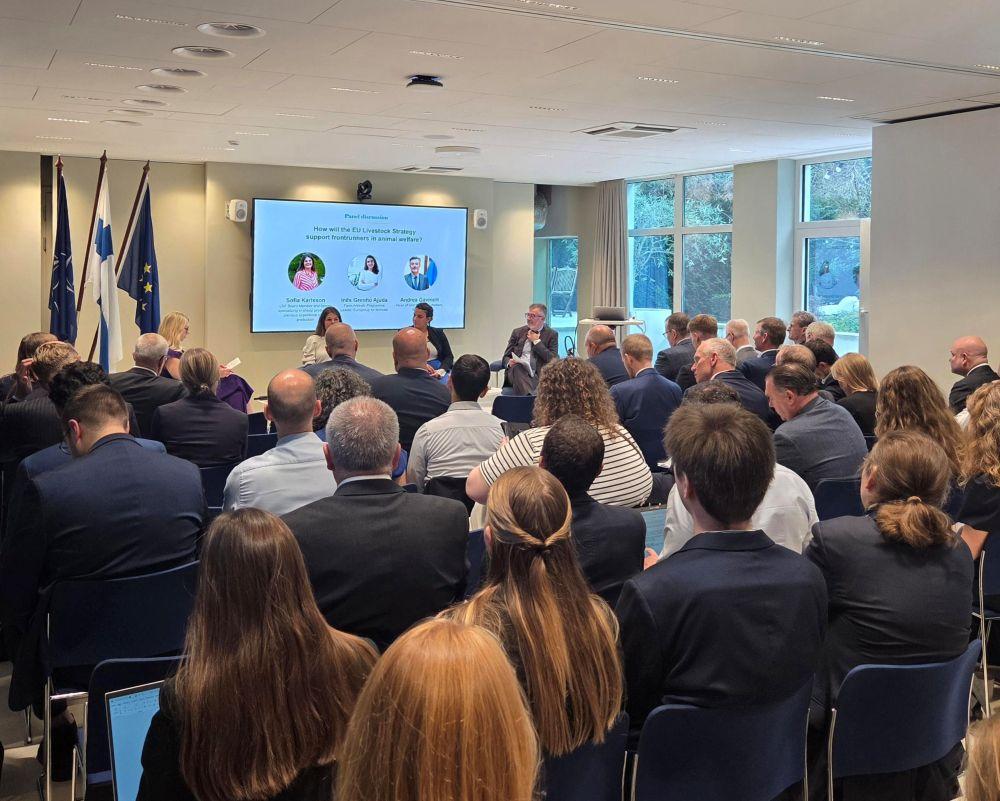
The seminar was held at the Finnish Permanent Representation, where Kari Valonen, Agricultural Counsellor of the Representation, welcomed the 80 guests in attendance. In the following opening speech, Pekka Pesonen from the Finnish Ministry of Agriculture and Forestry welcomed the Commission’s initiative and stressed that the Livestock Strategy concerns food security as part of EU security, not just food supply. He noted that livestock farming sustains life in areas where other activities cannot do so to the same extent, that "one size fits all" does not suit the EU, and that "in diversity we align". He also pointed out that livestock farmers who are not economically viable cannot invest in better animal welfare.
A keynote speech by Elisabetta Siracusa (Director for International Affairs, DG AGRI) set the stage for the first panel discussion. She highlighted the importance of livestock production for food security, jobs and biodiversity, recognizing that roughly 40% of EU agriculture consists of livestock. She presented five priorities: resilience, competitiveness, with simplification as a tool, science-based sustainability, including future measurement of livestock emissions, territorial balance, and excellence. On excellence, she argued that the EU should not compete on price alone and should communicate more effectively the quality, animal welfare standards and low pesticide use of its products, as providing the right information can help raise demand.
The speakers in the first panel were Jan Laustsen (Director for Trade and Market Relations, DAFC), Pekka Pesonen and Elisabetta Siracusa. The discussion was moderated by Rose O’Donovan, Editor of Agra Facts, and was based on the headline “Trade opportunities for the Nordics.” Jan Laustsen stressed that strong domestic production and exports reinforce each other, noting that Denmark exports around 70% of its production. He called for competitiveness and sustainability across the entire value chain, continued investment and closer Nordic cooperation in an uncertain geopolitical environment. Pekka Pesonen highlighted Nordic strengths in diversification, risk management and climate adaptation, while encouraging engagement with NGOs. Elisabetta Siracusa underlined livestock’s permanent role in EU agriculture and noted that new animal welfare standards for imports are being prepared.
The second panel, “Supporting animal welfare frontrunners”, was introduced by a keynote speech given by Andrea Gavinelli, Head of Unit for Animal Welfare, DG SANTE. He described the Livestock Strategy as a good mix of innovation, animal welfare and sustainability. He said investments should be pragmatic and deliver both animal welfare and resilience. He noted that the current system for protecting animals is not effective enough and called for a move towards cage-free systems, starting with laying hens.
The panellists in the second panel included Sofia Karlsson (LRF board member), Inês Grenho Ajuda (Farm Animals Programme Leader, Eurogroup for Animals) and Andrea Gavinelli. Sofia Karlsson stressed that leadership on animal welfare is costly for farmers and that higher standards must be supported by market demand and fair compensation. Inês Grenho Ajuda agreed that the Nordics are frontrunners in some respects, while noting that measures must reflect sector-specific needs and the gap between consumer values and purchasing choices. Andrea Gavinelli connected these concerns to the need for targeted investment and a stable, predictable policy framework.
Closing remarks were given by Palle Borgström, President of LRF. He noted that the livestock sector is changing in a positive direction and has been unfairly blamed for climate change. Livestock remains a cornerstone of agriculture. The geopolitical situation and global competition both affect the sector. The path ahead requires investment and hard work from farmers, and those who perform well should be rewarded. An increasing number of consumers are willing to pay for quality.
topics: kansainvälinen toiminta